
Airport Information
Mesa Gateway Airport (KIWA) is located in southeast Mesa, Arizona, approximately 30 miles east of Phoenix. Below you’ll find essential data for pilots, including airport elevation, runway specifications, tower frequencies, and navigation aids. For additional questions, contact Gateway Aviation Services at +1 (480) 988-7700.
Mesa Gateway Airport (KIWA)
Airport Details
| Associated City | Phoenix |
| Airport Elevation | 1,384′ MSL |
| Coordinates | N33 18.47′ W111 39.33′ |
Airport Details
Mesa Gateway Airport Authority
5835 South Sossaman Road, Mesa, Arizona 85212
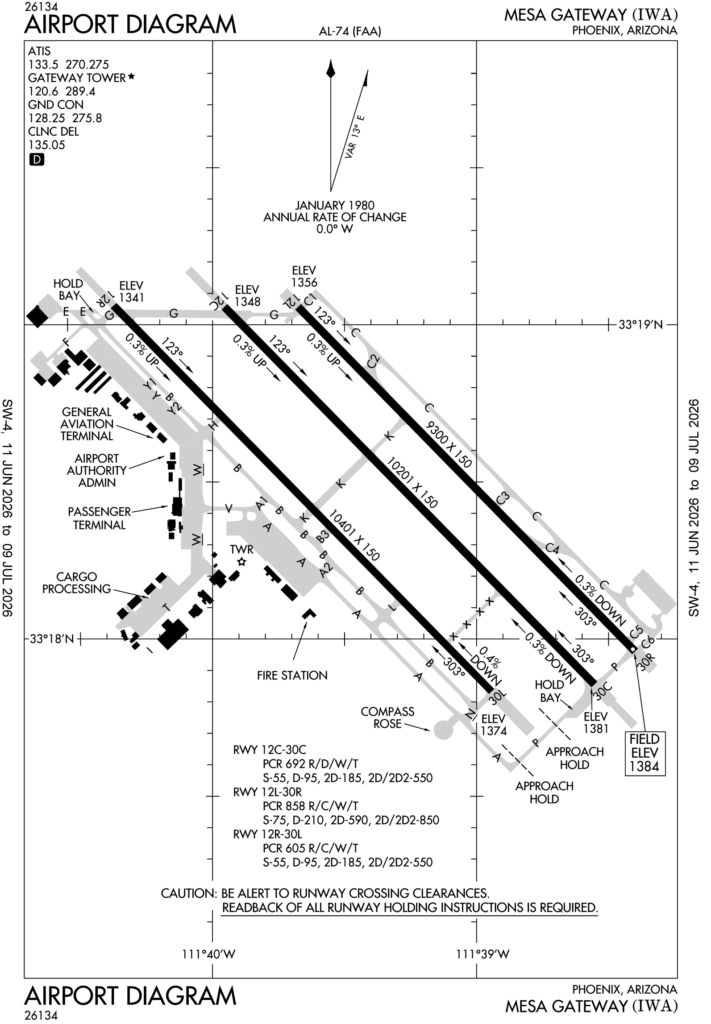
Airport Diagram
Runway Data
| Runway | Dimensions | Surface Type | Single | Dual | Dual Tandem | Complex Dual Tandem |
|---|---|---|---|---|---|---|
| 12R/30L | 10,401’ x 150’ | Concrete | 55 | 95 | 185 | 550 |
| 12C/30C | 10,201’ x 150’ | Concrete / asphalt | 55 | 95 | 185 | 550 |
| 12L/30R | 9,300’ x 150’ | Concrete | 75 | 210 | 590 | 850 |
Air Traffic Control and Communications Data
Gateway tower hours of operation: 0500-0000L (1200-0700Z) daily
Gateway tower
120.60
Gateway ASRI (FBO)
129.875
Gateway ground
128.25
AWOS weather data
133.50
+1 (480) 988-9428
Clearance delivery
135.05
ILS runway 30C
110.15
ATIS delivery
133.50
VORTAC
113.3 CH 80
Airport Remarks
- Airport attended 24 hours
- Aircraft Rescue and Fire Fighting (ARFF) services provided by Mesa Fire and Medical 24 hours daily (Index C)
- For unscheduled air carrier operations, please call the FBO at +1 (480) 988-7700
- Transient aircraft parking on north ramp access from taxiway Yankee between Yankee 2 and Yankee 3
- Fueling and aircraft ground handling services by Gateway Aviation Services, +1 (480) 988-7700, ASRI 129.875
- World Fuel Jet-A turbine and aviation gasoline (100LL) fuels
- DLA contract for U.S. Government and military operations
Noise Abatement
Mesa Gateway Airport strives to be a good neighbor to our surrounding communities. We ask pilots to help us achieve this by following our Fly Friendly procedures:
- Runway 30 is designated as the calm wind runway.
- Use best rate of climb, consistent with safety and Air Traffic Control procedures.
- Runway 12L/30R for jet aircraft pattern work (3100ft MSL) is preferred. When using Runway 30R, start right crosswind turns as soon as practical to avoid residential areas north of the Airport.
- Jets are requested to use NBAA Standard Noise Abatement Departure or comparable aircraft manufacturer procedures.
- Propeller aircraft requested to use AOPA Noise Awareness Steps.
- Helicopter traffic avoid low overflights of noise sensitive areas.
- Compliance with fly friendly procedures are appreciated and at pilot’s discretion.
Download our Pilot Card for more information and a map of noise sensitive areas.